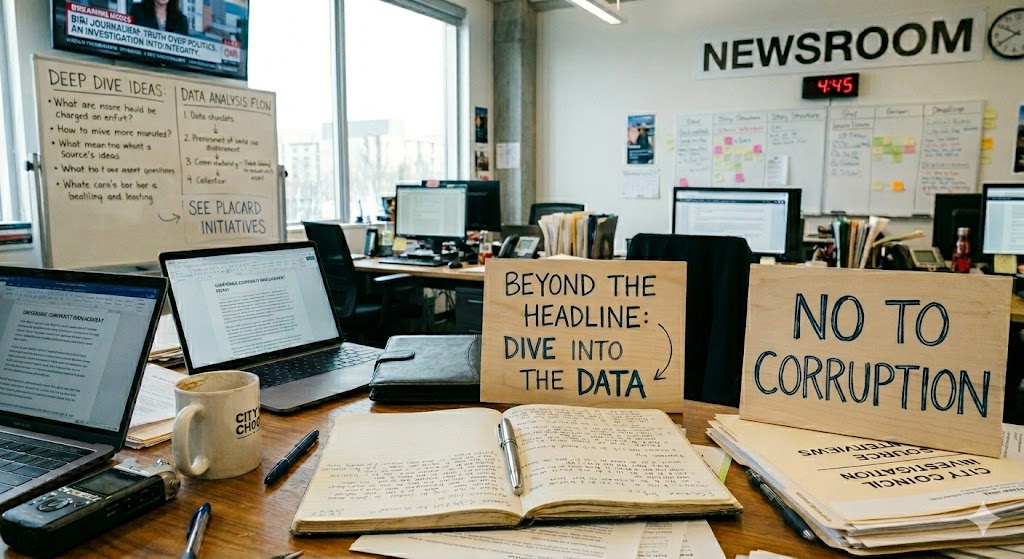
The Weight of the Word: Journalism Beyond the Headline

Contributed by Denise Angela Ofilada, Journalism student, PUP College of Communication

Beyond a career, journalism is a commitment to the truth. Awareness is vital, as journalists serve as the primary educators of the public.

We grow up believing the government exists to protect us, but growing up also means growing wiser. As inflation rises and hunger spreads, we realize our suffering isn’t born from a lack of effort—it is the result of a system that is actively pulling us down.

When we finally recognize that we are being taken advantage of, we face a choice: some choose to swallow the pain and turn a blind eye, while others gather the courage to speak for those who cannot.

This courage often manifests in the work of activists and journalists, who—against all odds—strive to shed light on systemic anomalies and continue to fight for what every Filipino deserves.

It makes you wonder: what was the turning point that led them to trade their silence for a megaphone or a pen? What do they truly think about a government they must constantly hold to account?

The Journalist as a Beacon of Truth

Tracy Althea Ramos lives between the realities of two sides. She’s a journalism student from the Polytechnic University of the Philippines (PUP) and an activist. Ethically, journalists are taught to stay neutral and unbiased, but that theory contradicts the practice of activism, which demands taking a definitive stand.
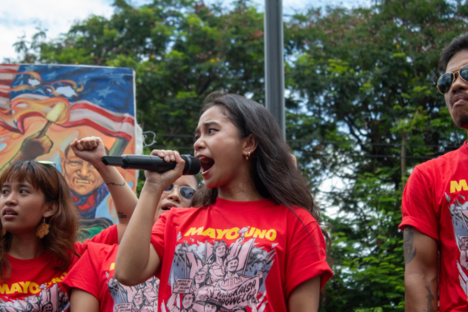
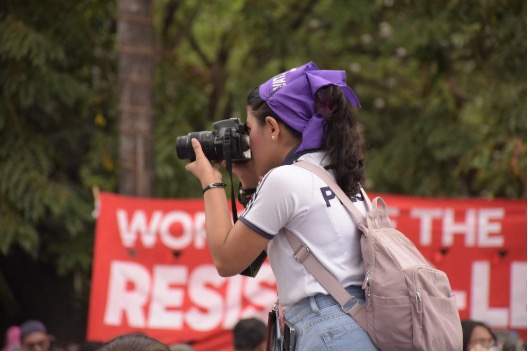
Photo of Tracy Althea Ramos from the 2026 “Mayo Uno” rally. Courtesy: Tracy Althea Ramos via Facebook.

Witnessing a systemic rot—exemplified by the 2022 election where underqualified candidates triumphed—compelled her toward journalism and activism. She realized that “wrong” electoral choices aren’t merely the fault of citizens, but the result of the ruling class’s information manipulation. By exploiting the marginalized’s lack of access to truth, these elites ensure that the most vulnerable continue to make uninformed political decisions.

Tracy is deeply committed to laborers’ rights. Growing up with laborer parents, she has firsthand knowledge of the government’s neglect of the working class. She argues that despite rising living costs, wages remain unlivable, forcing households to stretch limited incomes while basic necessities like oil and rice become unaffordable. According to Tracy, this exploitation is not a simple economic issue but stems from the greed of those in power, who deliberately keep workers in poverty to serve their interests.

As a journalism student, it is in Tracy’s heart to inform people of what is happening to our society. “Importante talaga na magkaroon ng marami pang mga bagong mamamahayag na gagampanan yung responsibilidad ng paglalaan ng oras, ng pagod, ng dugo’t pawis at ng panahon na ipahayag kung ano yung tunay na nangyayari sa lipunan,” she stated.

Beyond a career, journalism is a commitment to the truth. Awareness is vital, as journalists serve as the primary educators of the public.

Based on her observations, some student journalists are not politically aware enough, which makes her quite disappointed. She believes that as a journalist, you should care enough to indulge yourself in discourses, “Anong ibabalita mo sa mga tao if in the first place hindi mo alam yung nangyayari sa lipunan?” she remarked.

Although journalists are expected to maintain impartiality, truth itself is not inherently neutral. For this journalist, active participation in political discussions is essential, as remaining silent or claiming neutrality in the presence of systemic injustice constitutes a neglect of journalistic responsibility.

Embodying the Role of an Activist-Journalist

She recalled that when she stepped into college and became an activist, she realized that we cannot fully rely on the government for social change, because the government is corrupt and feeds on people’s adversity. Tracy believes that even though electing the right people to lead is crucial for good governance, the fight should not stop there.

Emotions drive Tracy’s resistance to oppression. She channels anger, disappointment, and betrayal into a protest against injustice. Tracy recognizes the fear involved in public demonstrations, but her experience as a journalist and activist has made her accustomed to being a “target” of state forces. She observes that armed forces are consistently present at rallies, including those held in front of the university.
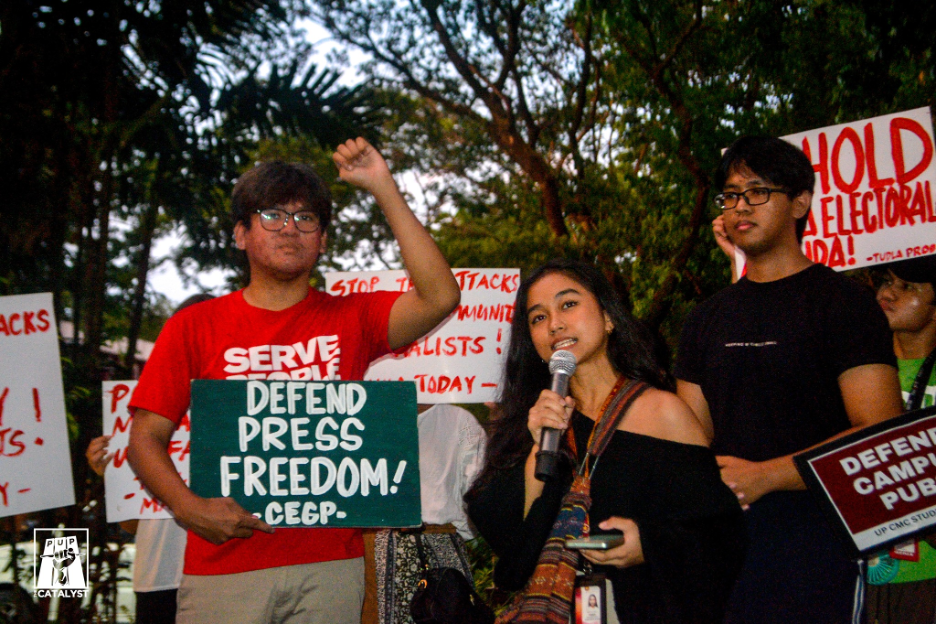
Courtesy: The Catalyst


What fight do activists and protesters that are armed with nothing but placards, megaphones and flags have against these deployed police that are armed with weapons and barrels? People have rights to complain, to organize mobilizations and head to the streets–rallies to not pose threats to society.

It might seem scary, but letting our voices be heard is one crucial way to achieve change, and for Tracy, to live in a world where the government continues to abuse its people is scarier. She hopes for everyone to participate in movements, not just to protest–but to learn and to empathize with people who are marginalized.

Tracy cannot be simply boxed into one word. Embodying both roles as an activist and a journalist, she shows that the truth should never be quiet and struggles should be broadcast. From the bold letters on placards to the words woven into articles, the Filipino people’s fight must shine on.

#journalism #politics #studentpointofview #truth #rubyspreciousmoments
 

The Politics Within the Frame

Contributed by Orlando Liwag, Journalism student, PUP College of Communication

In the landscape of Philippine politics, where narratives can be reshaped and accountability easily blurred, photojournalists do more than document events—they preserve them.


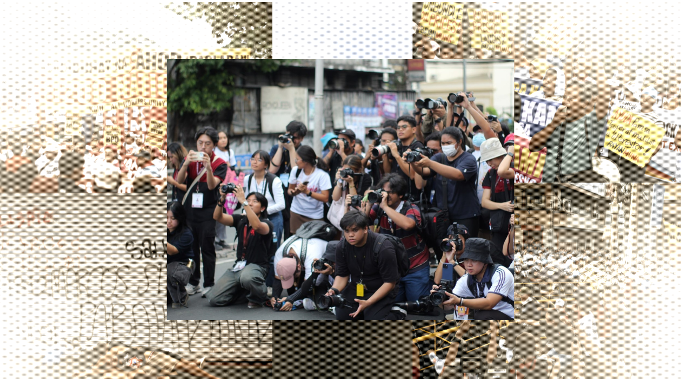
Amidst the chanting crowd, a protester raises a placard whose message demands to be heard. A camera lifts. A shutter clicks.

The photograph is silent, yet the images captured by campus photojournalists Roselle Ochobillo and Hanz Gabriel Ramos scream with the deafening anger of the streets. Each picture captures the raw struggles of the masses that words alone cannot express.

In the landscape of Philippine politics, where narratives can be reshaped and accountability easily blurred, photojournalists do more than document events—they preserve them. Their images stay, even when the attention fades. With their lenses, scattered scenes begin to form a single, striking picture of the present—bringing the reality of Philippine politics up close through the viewfinder.

Changing the Frame

Ochobillo’s political awakening began in the eighth grade, but she admits her early view of the government was shallow, rooted in the belief that high-ranking leaders existed to be obeyed. Joining her college publication, The Communicator, and working on the ground exposed her to a rotten system. “Doon na mismo binago yung pananaw ko na ano na nangyayari sa bulok na sistema to? Bakit ba ganito yung gobyerno natin?” she recalls.

Photo of Roselle Ochobillo covering the International Women’s Day protest, March 8, 2026. Courtesy: Chloe Reodica/ The Communicator

It was on the streets where her focus shifted entirely to the struggles of the community. “Doon ko mismo napagtanto na mas malalim pa yung sitwasyon o yung [kinalalagyan] ng lipunan, o yung mga taong nasa laylayan o mga nasa sektor, mga manggagawa, mga mangingisda, [at] mga magsasaka.

This shift pushed her to put down her pen and pick up a camera. While she began her campus journalism career in the opinion and editorial section, she made the leap to photojournalism after recognizing that readers need powerful images to truly connect with a story.

“Yung mga larawan na nakukuha natin, parang mas nagbibigay buhay siya doon sa mismong istorya na sinusulat natin,” she says, explaining how audiences today are more drawn to visuals. Through her lens, she continues to reframe not only how she sees politics, but how it is seen by others.

Viewfinder: If politics were a picture

If Philippine politics were reduced to a single photograph, Ramos envisions a chilling juxtaposition: high-ranking officials standing at a zoo, looking through a glass enclosure at the crocodiles inside. The reflection blurs the boundary, turning the glass into a mirror that reflects the true nature of those in power.

For Ramos, this imagined picture captures a system where corruption starts at the very top and quickly spreads down to everything else. “Parang nagdo-domino effect na rin yun sa ibang issues na kailangan pang lutasin,” he explains.

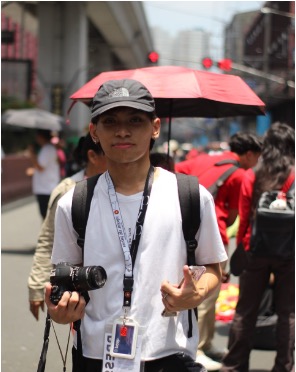
Photo of Hanz Gabriel Ramos during his coverage of the 2025 “Mayo Uno” rally.

On the frontlines of protest, his experience goes beyond simple coverage. “Mas napi-feel mo yung galit ng mga tao…lalo na sa mga sigaw at panawagan nila,” he shares. That intensity, he says, pushes him to capture not just the event, but the emotion behind the protesters. “Kung gaano kalakas yung boses nila, gano’n ko kalakas gusto ipakita sa pictures yung mga panawagan din nila.”

In Ramos’ viewfinder, politics is not a single, simple shot. It would not be clean or composed—it would be layered, uneasy, and unresolved, a reflection of the reality caught in these photojournalists’ lenses.

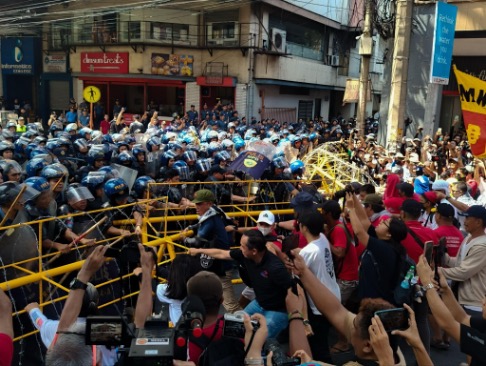
Workers from different sectors staged a large-scale protest to commemorate International Labor Day, which was blocked by police along Recto Avenue on May 1, 2025. Courtesy: Roselle Ochobillo/The Communicator.

Beyond the Shutter

The click of a camera is often seen as the final step in capturing a story, but for Ochobillo and Ramos, it is merely the beginning.

For Ochobillo, the true realization of her work hits when she watches exhausted protesters pack up to leave. As placards are lowered and the streets begin to clear, a different kind of silence settles in.  “Tapos na yung araw na yun pero hindi ang laban nila…babalik sila sa pagawaan, sa mga sakahan sa pangisdaan. Lalo na yung sobrang vivid ng moments na nakasakay sila sa jeep tapos kumakaway sila.” It is in these quiet moments that she realizes the struggle is far from over, the demands they shouted for remain unmet.

While keeping her professional duty to document the truth, she refuses to separate herself completely from the struggles of the masses, choosing to march and shout alongside them. She stands her ground even when the situation turns perilous.“Nandoon yung takot, nandoon yung kaba. Pero nandoon din yung paninindigan mo na mag-stay doon sa mismong lugar, na gamitin pa rin yung camera mo, cellphone mo, to capture the moment,” she admits.

For her, campus journalists and alternative media are a crucial line of defense against skewed narratives that often unfairly blame the marginalized for the social tension and conflict. She believes that the true power of photojournalism is archiving the truth. By saving these raw moments, their images become permanent, clear proof.

Ramos carries this same sense of responsibility through a strict demand for systemic accountability. He strongly refuses to treat the government as a mere “circus” or joke, arguing that doing so turns corrupt authorities into a “laughing stock” and normalizes toxic Filipino resilience.

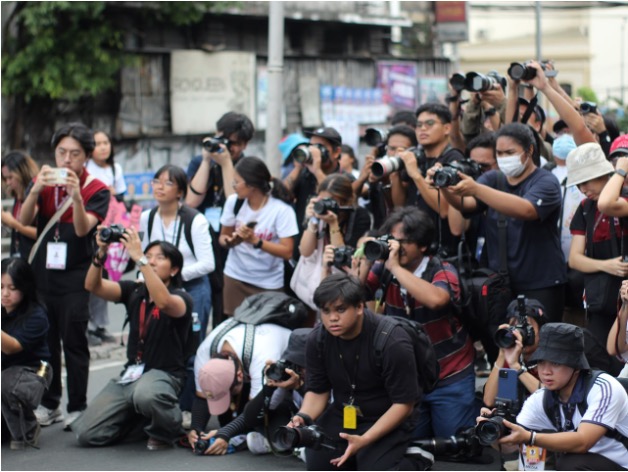
Photojournalists capture protesters crossing the McArthur Bridge in Manila on May 1, 2025. Courtesy: Hanz Gabriel Ramos.

He believes words alone are no longer enough to expose this chaotic system. “Hindi na nagiging effective in a way yung mga articles lang alone,” he says, explaining why photojournalists are vital in today’s digital age. Photojournalism, he adds, is what helps the public truly see the consequences of these failures.

Still, exposing these harsh realities through images does not erase the struggles on the ground. Beyond the shutter lies a reality that neither Ochobillo nor Ramos can simply walk away from.  The problems don’t end once the camera stops clicking. Every rally, every protester, and every raised placard becomes part of a larger picture of a nation still burdened by inequality, corruption, and unresolved struggles.

#PhilippinePolitics #photojournalism #journalismstudentpointofview #rubyspreciousmoments #rubyasoyph