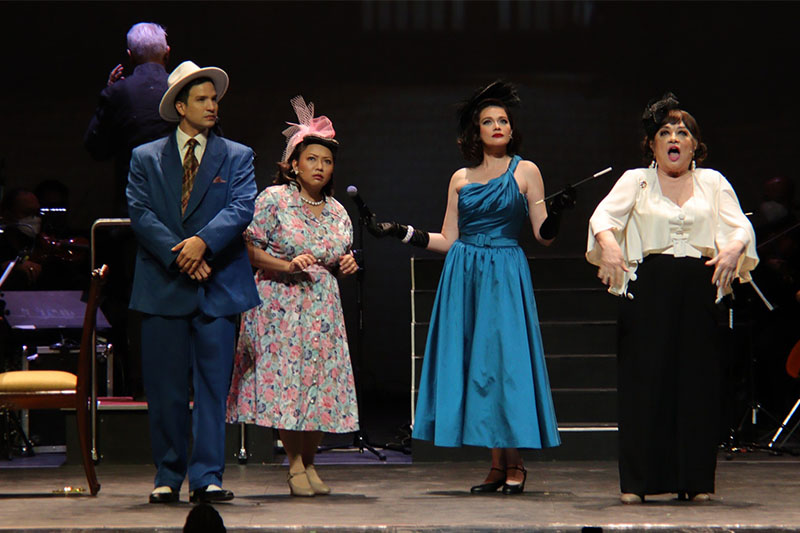
Where law meets heart – the musical tells us that “Justice is not just a profession; it is a calling shaped by empathy, integrity, and humanity.”
“Bar Boys: The Musical” is a stage adaptation of Kip Oebanda’s 2017 film of the same name. It was produced and staged by Barefoot Theatre Collaborative. The musical had its previous run in 2024. This revolves around a group of four friends who are aspiring lawyers in a law school. They have different personalities, but they share the same goal of changing the justice system in the Philippines.

The musical play presented a more flavorful take than the original film. It brings an in-depth portrayal of the four male protagonists — Erik Vicencio (Benedix Ramos), Chris Abueva (Alex Diaz), Torran Garcia (Jerom Canlas), and Josh Zuñiga (Omar Uddin) leveled up with upgraded characterization. Ramos and his emotional interpretation of Erik did not gain control over his powerful vocal ability, making his performance flawless throughout the show. His outburst at the Bar Exam scene with the song “Lakompake” showcases his rap ability and amazing madness on stage, justifying the character’s fury and grief over his father’s death.
Diaz effectively played Chris as the most outwardly confident among the leads. His natural charismatic and well-spoken portrayal fits him for the role since his fluency in English helps. Uddin’s Josh made the narrative more real. He justified his role as someone with strong idealism. His presence in the storyline balances the tone of the show, showing the perspective of a man providing contrast to the trajectories of the other three characters.
Canlas, however, originated Torran as a closeted character in the show, which is not similar to what Rocco Nacino presented on the film. This makes the musical LGBT-friendly, as though he represents Torran’s arc that involves admitting his feelings and identity to her mother. Torran’s chemistry with the character of Victor Cruz (Gio Gahol) thrilled the audience on how their scenes gave flavor to the show. Gahol handled the role with dignity and depth, breaking the cliched “gay rope” pitfalls. His relationship with Torran is not made overly sexualized but emotionally resonant.
Law school, being represented in the show, pushes each character to the brink — but their friendships keep them grounded. The musical shows that success is empty if it costs you the people who hold you together.
The song “May Singil Ang Pangarap,” which is one of the central thematic numbers, captures the emotional and social cost of pursuing the dream of becoming a successful lawyer. It serves as a musical thesis for the struggles the characters in the show endure, and it works on multiple layers, whether individual, relational, or systemic. It highlights the universal painful truth of every person’s dream demands something in return like money, relationships, and even one’s sense of self.

Shiela Francisco, meanwhile, who played Justice Hernandez, added that motherly effect to the character originated by Odette Khan in the film. She embodied a morally grounded and dramatically rich character. Francisco did not change how Khan’s dramatis persona is perceived by the audience based on the picture. She boosted Hernandez in the musical as the bridge between generations. Her character ties together with the weight of tradition with the youthful hopes of change. Her delivery of “Dear Future Lawyers” song number innately shows how well-trained she is for being a veteran in the theatre arts.
Other cast members include: Juliene Mendoza and Lorenz Martinez (alternating as Paping), Nor Domingo (as Atty. Maurice Carlson), Gimbey Dela Cruz (as Boss Mama), Natasha Cabrera (as Chris’ mother/female professor/judge), and Carlon Motabato (as male professor/law student’s father).
The covers for the main cast include Ian Pangilinan (Chris), Shaun Ocrisma (Victor), Jude Hinumdum (Erik), Chino Veguillas (Paping/Atty. Carlson), and Naths Everett (Justice Hernandez/Boss Mama/Female Professors & others). While the covers are already given, the show also has Ace Polias as the male swing, and Aecy Abne as the female swing.
With Ade Valenzona and Mijon Cortez returning as part of the ensemble, they are joined by Sheena Belarmino, Dippy Arceo, Pappel, Denize Castillo, Keith Sumbi, Ammin Acha-ur, Gelo Lantaco, Daniel Wesley, Elian Dominguez, Curp Adriano, Robe Zamora Dagcuta, Joshua Rico, and Leo Lapitan.
The show is not perfect, but indeed inspirational to all people, regardless if the spectators are law students or not. Some scenes are not rooted in Oebanda’s film. Chris’ father in the film is not depicted as a politician and is not estranged by Chris. Erik’s mother is not really dead in the film too. These changes applied in the show indicated as a theatrical amplification or reinterpretation for dramatic effect. These insertions by the playwright make the plot more developed and relatable to suit the needs of the stage musical. The set design is on-point and necessary for all scenes to create realistic storytelling. The musical was apparently written with invectives clearly spoken, mentions of sex, and other mature themes involved, which can be considered PG-13.
In addition, the musical does not only bring in discussions about the aforementioned queer legal-right issues, it also involves the reality—reference to the outside world issues such as the flood control/ghost projects of the government, shades for corrupt politicians built on featured characters, and other several political controversies. This resonates the country’s current situation—calling for justice against injustices. In spite of these contributing conflicts presented in the performance, Bar Boys: The Musical tells us that “Justice is not just a profession; it is a calling shaped by empathy, integrity, and humanity.” It is reiterated to all human beings who want to change a negative society, most especially those aspiring lawyers who aimed to change the country’s spoiled system. It communicates to people to stand firm whatever challenges will come. You may never be ready, but always be prepared.
“Bar Boys: The Musical” was spearheaded by Pat Valera (book and lyrics), Myke Salomon (music), Jomelle Era (choreography), and Pat Valera and Mikko Angeles (direction).
Contributed by Rayne Jarabo
#BarBoysTheMusical #rubyspreciousmoments #rubyasoyph